Get 10% off your first order


Wedding stationery etiquette covers the timing, wording, addressing, and presentation conventions that shape how your invitations and paper elements are received by guests. Understanding the essentials ensures your stationery reflects the care you have put into your event, from the first save the date through to the on-the-day pieces.
1. Do start early
One of the crucial aspects of wedding stationery etiquette is timing. Begin working on your stationery early in the planning process to avoid any last-minute rush. Give yourself enough time to design, proofread, and print the invitations, ensuring they are sent out with ample notice. For semi-custom and bespoke suites, allow 8–12 weeks from ordering to delivery; for save the dates, allow additional lead time on top of that.
2. Don’t forget the save the dates
Save the date cards are an excellent way to announce your wedding and ensure that your loved ones can mark their calendars well in advance. Send out these cards at least six to eight months before the wedding date, allowing your guests to plan accordingly. For destination weddings or events over major public holidays, a full 12 months is advisable to give interstate and international guests adequate time to book travel and accommodation.
3. Do include all necessary details
When it comes to wedding invitations, it is essential to include all the necessary details your guests need. This means the names of the hosts, the couple\’s names, date and time, ceremony venue, reception location and time, dress code, and RSVP information. A separate information or details card is the appropriate place for accommodation recommendations, parking guidance, and wedding website URLs — keep the main invitation clean and focused on the essential who, what, when, and where.
For guidance on wording each of these elements, read our complete guide to wedding invitation wording — it covers everything from the host line to RSVP conventions with Australian-specific examples.
4. Don’t neglect proper wording
Use language that reflects the tone of your wedding and includes all the essential information. Avoid abbreviations or informal language that may detract from the elegance of the invitation. The register of the wording should match the register of the event — a black-tie reception calls for formal language throughout; an intimate garden ceremony can be warmer and more personal without sacrificing clarity. If in doubt, err on the side of formality: a slightly more formal invitation is rarely the wrong choice, while an overly casual one can feel misaligned with a more considered event.
5. Do proofread thoroughly
Before finalising your wedding stationery, proofread everything meticulously. Check for spelling or grammatical errors, confirm that every date, time, and venue name is accurate, and verify that the RSVP deadline and contact details are correct. Consider having a friend or family member review the content as well — fresh eyes will often catch errors that familiarity has made invisible. Check the date against a calendar to confirm the day of the week matches the date, and confirm the suburb and postcode for every venue listed.
6. Don’t overlook RSVP etiquette
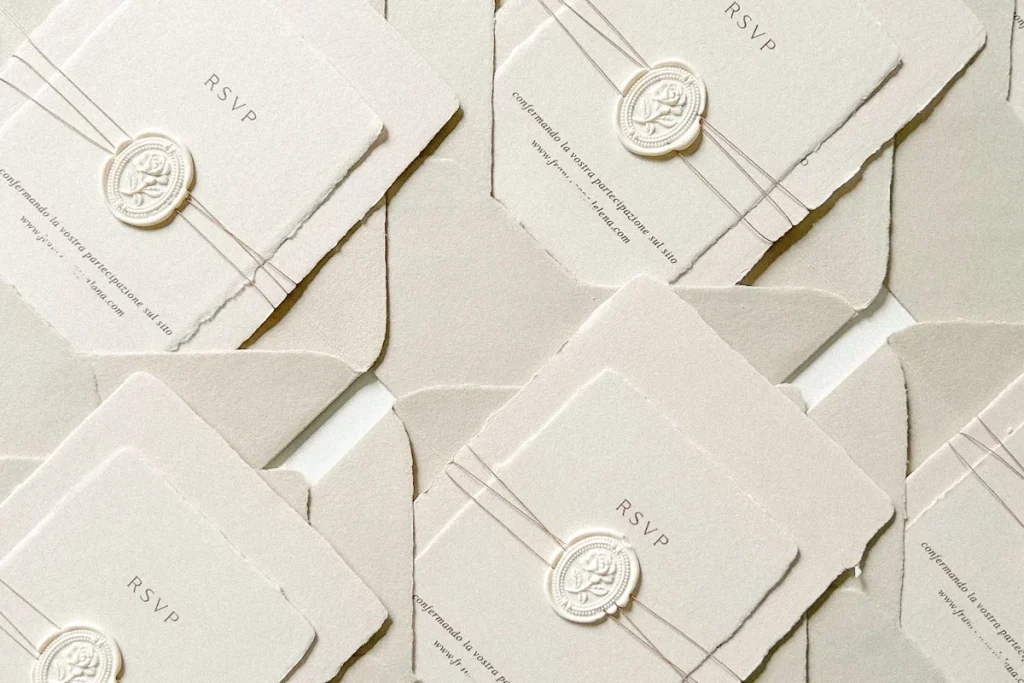
Include a response card or provide clear instructions on how guests should RSVP. Set a reasonable deadline, typically four or more weeks before the wedding, to give yourself adequate time to finalise numbers and catering. If you are using an online RSVP form via your wedding website, include the URL clearly on a separate card — but also include your phone number or email address for guests who are less comfortable with online tools. A pre-addressed, stamped reply envelope accompanying the RSVP card removes a practical barrier and increases the return rate for physical RSVPs.
7. Do consider additional stationery needs
Beyond invitations, there are other stationery elements you may need for your wedding. Ceremony programs, menus, place cards, table numbers, seating charts, and welcome signs all benefit from a consistent design language that ties the suite together. Paper Alchemy\’s semi-custom collections cover every piece from save the date to on-the-day stationery within the same aesthetic framework, ensuring your invitation suite and day-of elements read as a cohesive system.
The finishing details on your invitation suite also deserve consideration: wax seals on the envelope closure, envelope liners on the interior, and ribbon tied around a flat suite all elevate the presentation before the invitation is even read. These details are noticed — by guests who care about craft, and in the flat-lay photographs that often become lasting keepsakes.
8. Don’t forget proper addressing and mailing
When addressing your invitations, follow proper etiquette by using titles and full names for formal addressing, and confirm the correct spelling of every name and address before printing. Use appropriate postage — a full invitation suite with inserts, a wax seal, and an envelope liner can exceed the standard letter weight limit and may require large letter postage. Weigh a fully sealed sample envelope before purchasing your postage allocation. For wax-sealed envelopes, hand-cancel at the post office counter to protect the seal from automated sorting machinery.
For couples with large guest lists, Paper Alchemy\’s envelope printing service handles the addressing process professionally, with typography matched to your invitation suite. Download our free envelope addressing template to prepare your guest data in the correct format.
What to Include in Your Wedding Stationery Suite
A complete wedding stationery suite typically encompasses two phases: the pre-wedding send and the on-the-day pieces. The pre-wedding send includes the save the date (sent 6–12 months out), the invitation suite (sent 6–8 weeks before the event), and any follow-up correspondence such as accommodation or transport updates. The invitation suite itself comprises the main invitation card, RSVP card, information card, and envelopes — with optional wishing well card, wedding website card, and reply envelope.
On-the-day stationery covers every printed element your guests interact with at the event: ceremony programs, menus, place cards, table numbers, seating charts, and welcome signs. A thoughtfully considered suite ensures the aesthetic your guests encounter on the day matches the invitation they received weeks earlier — it is the difference between a stationery suite and a stationery system.
If you are unsure which elements your event requires, Paper Alchemy\’s team is happy to advise based on your venue, event format, and guest count. Browse our full range of wedding invitation collections or get in touch to discuss your suite scope.
Wedding stationery etiquette is ultimately about thoughtfulness — communicating the right information, in the right format, at the right time, with the care that signals to your guests how much their presence matters. Paper Alchemy is a Sydney-based luxury stationery studio dedicated to helping couples achieve exactly that, across every piece of their suite.